


I’ve become a big fan of Michael Munger. Most famous perhaps for being the most frequent guest on the venerable EconTalk, he has his own excellent podcast, The Answer is Transaction Costs. In a July 2025 episode of EconTalk, Munger defines capitalism and describes its evolution in a way neither Russ Roberts nor I had heard before.
I’ve determined it is the objectively correct definition of “capitalism.”
In this essay, I will convey Munger’s definition of capitalism and defend its superiority.
The stadial theory has three nested stages:
Voluntary Exchange
Markets
Capitalism
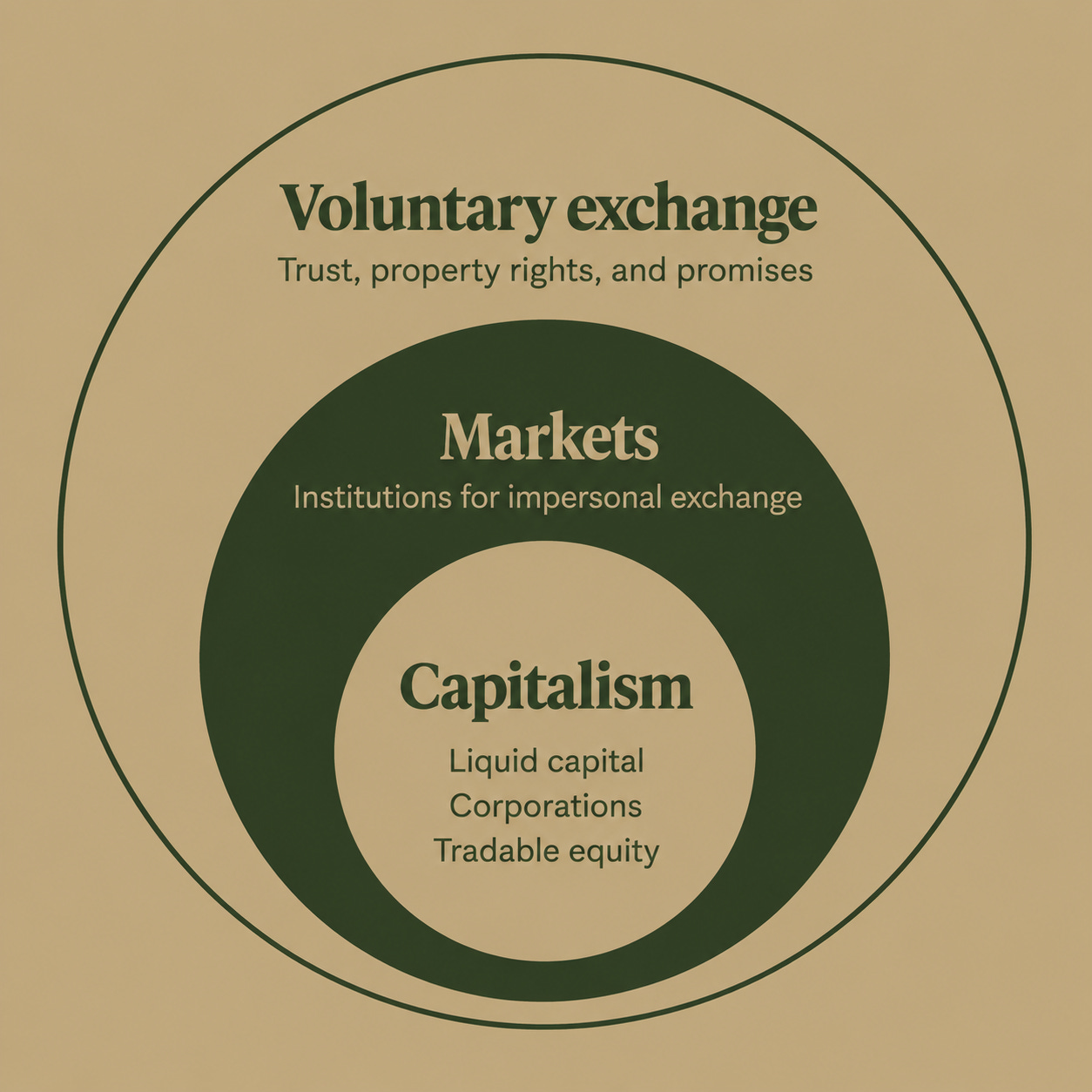
Voluntary Exchange
Every society engages in some form of trading goods and services. Adam Smith described as a part of human nature “the propensity to truck, barter, and exchange one thing for another.” The positive-sum exchange of labor and property leads to consumer and producer surplus, i.e., gains from trade. Munger, building on Smith, emphasizes the significance of “propriety” and “justice” being developed in a culture to facilitate “long-term reciprocal relation[s].” One could describe this as building up a baseline of enlightened self-interest and reciprocal altruism to facilitate commerce.
Munger describes Smith’s theory of justice as:
Justice is abstaining from what is another’s. And it has three parts: person, property, and promise. I become committed to not taking someone else’s stuff; I become committed to not interfering with another person’s life; and I become committed to carrying out my promises for their own sake. And, the impartial spectator approves of this.
Bluntly, you can’t have effective commerce without property rights, voluntary participation, and basic moral standards grounded in self-interest. These foundational mechanisms and principles then require certain institutions to scale and become markets. Munger channels Douglass North to define markets as a “set of institutions for reducing the transactions cost1 of impersonal exchange.”
Markets
Scale requires facilitating impersonal exchange and one-off transactions, which includes a general sense of trust and commitment to the version of justice described above. Institutions needed for markets include the formal, consistent rule of law to protect property rights and enforce contracts. Another is money (and sound monetary policy) to facilitate easy exchanges with basically anyone for basically anything. The capability to issue debt allows intertemporal exchange at a basic level. Greater scale enables greater productivity gains from the division of labor, specialization, and comparative advantage. Market prices are signals, wrapped in an incentive — they dynamically convey information and motivation at scale to consumers and producers to drive the efficient allocation of resources via decentralized coordination and thereby spur production for supply to meet demand.
Capitalism
Liquid magic
Building on the scale, norms, and institutions developed in the prior stages, Munger describes the final stage: “Capitalism is a set of specialized market institutions that allow time travel.” In a word, liquidity. Similar to how markets facilitated impersonal voluntary exchange at scale and debt enabled it over time, the existence of liquidity in large capital markets allows moving value to fixed, physical assets, over time and space. Intertemporal investments are incentivized for borrowers and lenders, with an evaluation of risk and reward for both parties. It robustly solves at scale the chicken-and-egg problem of how to get development going from ~nothing.
Shares of profits
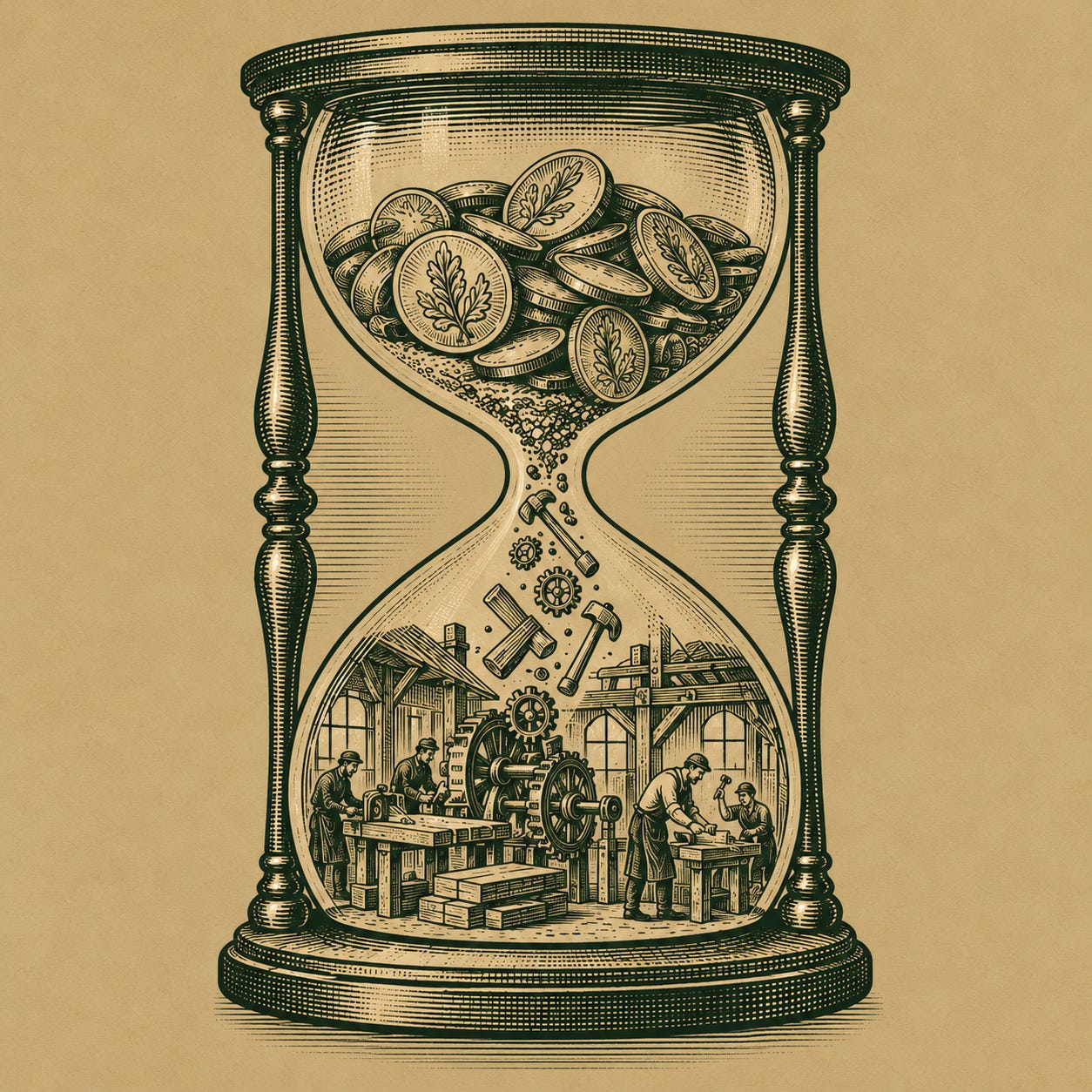
Another critical institution is being able to “sell shares in the profits that don’t yet actually exist.” Beyond the ancient utility of debt, what capitalism “requires is a set of financial markets that allow thick trading where [when] you get prices, you are pricing the future value of a corporation that doesn’t exist.” Liquidity, the corporation, and the stock market unlock massive growth potential via dynamism. Together, these allow entrepreneurs and investors to experiment with answers to the question: What would consumers buy if we could make it for them? You can just try things, under capitalism. Sensible risk-taking is incentivized.
This is a major leap because, while having debt repaid can create profits for both lender and borrower, it has less potential benefit and more downsides. There is far more upside potential for an investor in owning shares of an eventually successful corporation. Plus far less of a burden and risk on a fledgling enterprise to sell shares rather than to take on debt. Business loans need to be repaid as a business grows, whereas growth in equity value is not restrained by having to settle debts and take on new loans. A capitalist system will therefore drastically outgrow a (purely) debt-financed system, because more efficient allocation of risk and reward is possible for innovators and entrepreneurs.
In a sentence
Capitalism is a socioeconomic system, inextricable from liberalism, whose culture and institutions support individual liberty, propriety, property rights, voluntary exchange, and free markets—enabling liquid capital markets to drive investment and innovation by incentivizing risk-taking among participants over time horizons.
This is why we have nice things
Number go up
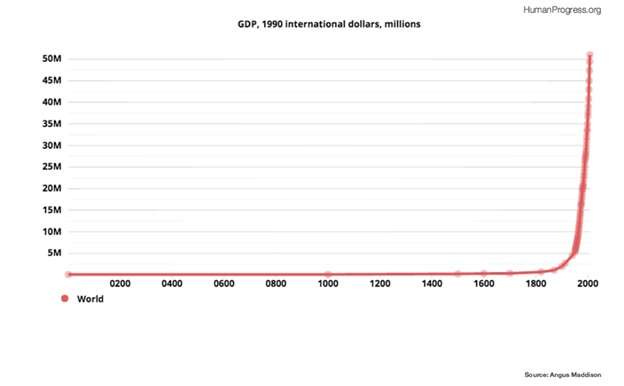
We got the Great Enrichment because the development of liberalism and capitalism combined with technological innovation to drive prosperity at scale. Note that Adam Smith was writing in the late 18th century, just as the Industrial Revolution was taking off and the United States was being founded. It’s hard to imagine anyone more correct in their grand theory predicting the future than he was in The Wealth of Nations. Economic growth is the single best variable one can aim at.2
Why economies fail
Understanding what brings about capitalism makes clear what prevents economic flourishing. Munger emphasizes, in accordance with Gall’s Law, that you can’t have the complexity and benefits of capitalism without the foundation of voluntary exchange and markets: “It’s hard to become a capitalist country because you have to have a set of institutions. Well, you need a different history. Basically. Doug North was right. For most countries, you would need a different history.” If you don’t have the basic norms of voluntary exchange, you are going to get extractive institutions.
An efficient, productive economy is grown, not designed. To succeed, it requires both cultural norms and formal legalistic standards, from the level of the individual to all of society. A society without a strong baseline of trust and property rights as civil rights has such high transaction costs that commerce cannot function efficiently and growth is inhibited: “Capitalism can’t be grafted on to a society that doesn’t have these attitudes and institutions already.”
There is only ethical consumption under capitalism
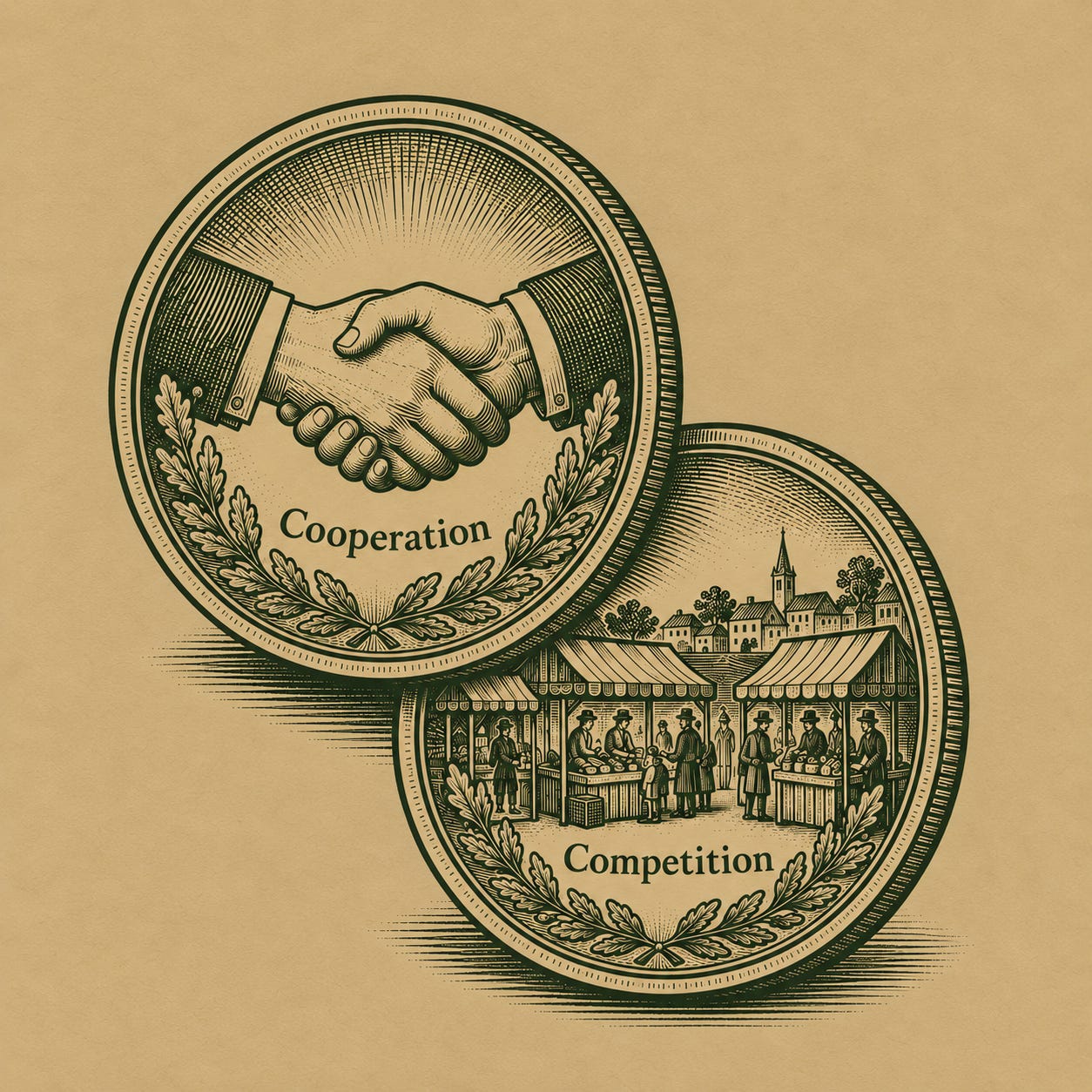
This conception of capitalism highlights what the typical critic refuses to understand. Capitalism requires and incentivizes ethical behavior; that Adam Smith was as much a moral philosopher as he was an economist is not coincidental. Empirically, we know the abundance generated from pro-social, positive-sum, enlightened self-interest does far more to help the unfortunate at scale through reducing scarcity than mere charity or coerced redistribution ever have. Capitalism takes flawed, overly self-interested human beings and rewards them for delivering goods and services others want. Cooperation is just as important as competition, and they are frequently two sides of the same coin — every transaction is necessarily cooperative and a competition for the best available deal.
Critics of capitalism want to emphasize greed, private ownership, inequality, and exploitation — so rarely acknowledging that no economic system eliminates all human problems, that scarcity is the state of nature, and that commerce and wealth are not zero-sum. In this reality-free view, prices are simply a dictated number that can be altered at whim with no repercussions. Incentives need not be assessed. Subsidies help when supply is held constant. No billionaire is valid. Government is by default good and corporations are inhuman(e). Deregulation is inherently bad. Utopia is one revolution away. They can compare their imagined utopia against the best available reality and their imagination wins every time.
You too can join the capitalist revolution
A related point, which could have saved humanity a great deal of suffering were it sufficiently understood, is the fact that under capitalism employees can be paid partly in stock. It aligns incentives because it provides upside with the success of the company. Additionally, anyone can choose to invest in publicly traded companies. Thus, everyone can be owners3 of the means of production.
Capitalists of the world, unite!
Immaterial considerations
Roberts points out at the end that material prosperity does not guarantee meaning or emotional or spiritual well-being. Smith wrote that we want to be “loved and lovely.” Munger agrees. Money is great, but “we can’t substitute commerce for society.” Similarly, liberalism has its origins in allowing competing religions4 to peacefully coexist, but may not itself suffice as a belief structure for any individual’s life satisfaction. These limitations are features, not bugs. No one idea or tool can solve all that is the human condition.
Munger likes to break down transaction costs into: triangulation, transfer, and trust.
GDP growth correlates with everything around me.
Please note that most pension systems are also based on investing in capital markets. Lots of workers also own a claim on the means of production and have no idea they too are capitalists.
An ongoing challenge for liberalism is handling severe disagreements between secular ideologies. It’s not unconstitutional to discriminate on political affiliation (including in much of government). Freedom of belief and freedom of association is a two-sided challenge.