

There are, in my experience, a number of basically incontrovertible facts that are insufficiently known by intelligent people, such that they hold misinformed views on key matters of political economy.1 The typical participant in the U.S. educational system may never encounter these facts, properly framed. This essay attempts to rectify that.2
As a lad, I was raised in the tradition of Reagan Conservatism and then converted in my teens to what we could call “Obama Neoliberalism” (i.e., the Center Left, Left Neoliberalism). Those were the glory days of Jon Stewart and Stephen Colbert. Life was simpler then, when reality had a well-known liberal bias. I would argue that it has and does, if one uses the original and proper definition of “liberal.”

As time went on, I became more and more aware of the inaccuracies and blind spots of the progressive canon, and the economic failures of policies favored by the American and global Progressive Left.3 These failures, I learned, were predicted by Classical Liberalism, public choice theory, and James Q. Wilson4. You may or may not find my personal shift to Classical Liberalism persuasive; the facts should still move you toward the neoliberal margin.5
An underlying belief I possess that led me to consider things the way I have is this: If we truly care about material progress and improving the lot of the disadvantaged—ostensibly the moral driving force of the Left—we should therefore rigorously care about achieving improvements with effective policy and efficient use of finite government resources. The Effective Altruism6 movement takes this approach—recognizing concepts like opportunity costs, diminishing returns,7 and impact levels—to charitable giving on a global level. It would be nice if there were, I don’t know, call it “Effective Progressivism,”8 to check on policy effects and ROI. They could do a lot better if they cared about results.9
As you read the following points, observe if you have the instinctual response to avoid debating them on the merits and shift to a reaction like “everyone already knows this”10 or “that doesn’t mean deregulation will make things better”11 or “what we need is better policy.”12 Or, “actually Social Security is neoliberal enough we just need more funding.” In other words, mind the gap between your factual and opinionated entitlements.
Entitled Facts
The Global War on Poverty
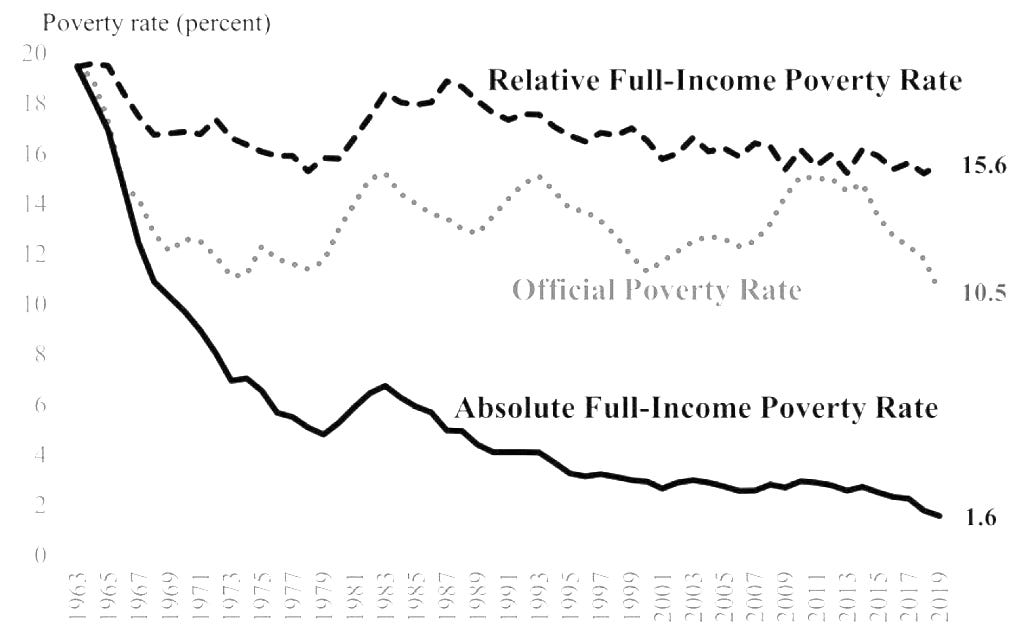
Common measures of poverty in the U.S. do not factor in all taxes and transfers. The very treatments implemented to address the issue. We already “won” the “war on poverty” in absolute terms to reduce suffering—as measured by consumption. The same stunt is often done for inequality. If you don’t move the goalposts and count existing policy interventions, we’re already largely post-scarcity and highly egalitarian—to the extent the U.S. is more progressive and redistributive than any European country by certain measures. Which is probably why poverty became positively correlated with obesity about the same time that bottom line in the chart dropped below 5% in the 1990s. Self-sufficiency, on the other hand…
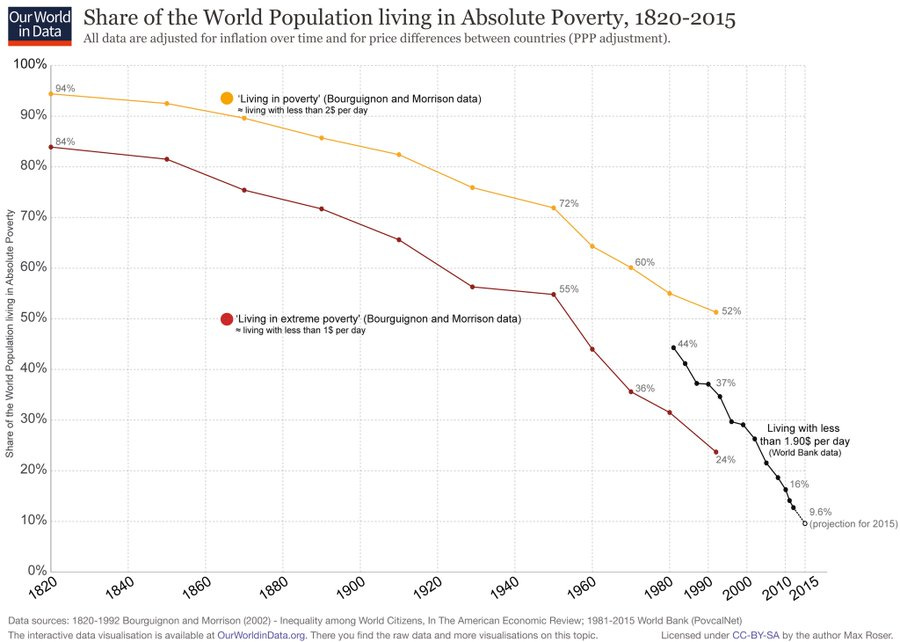
This great news extends to most of the world. At this point, suffering from scarcity is almost always the result of entrenched political/societal dysfunction or conflict, not lack of charity or redistribution. This is plainly from the growth in global GDP as a result of market economics13 and technological progress, not redistribution.14 Progressives tend to be strongly nationalistic in their redistribution aims and views on trade, and often desire to impose higher regulatory and moral standards for developing countries, which are not yet affordable, thereby supporting policies that hurt the global poor. Sweatshops and child labor are a necessary evil good, actually.
The Price is High
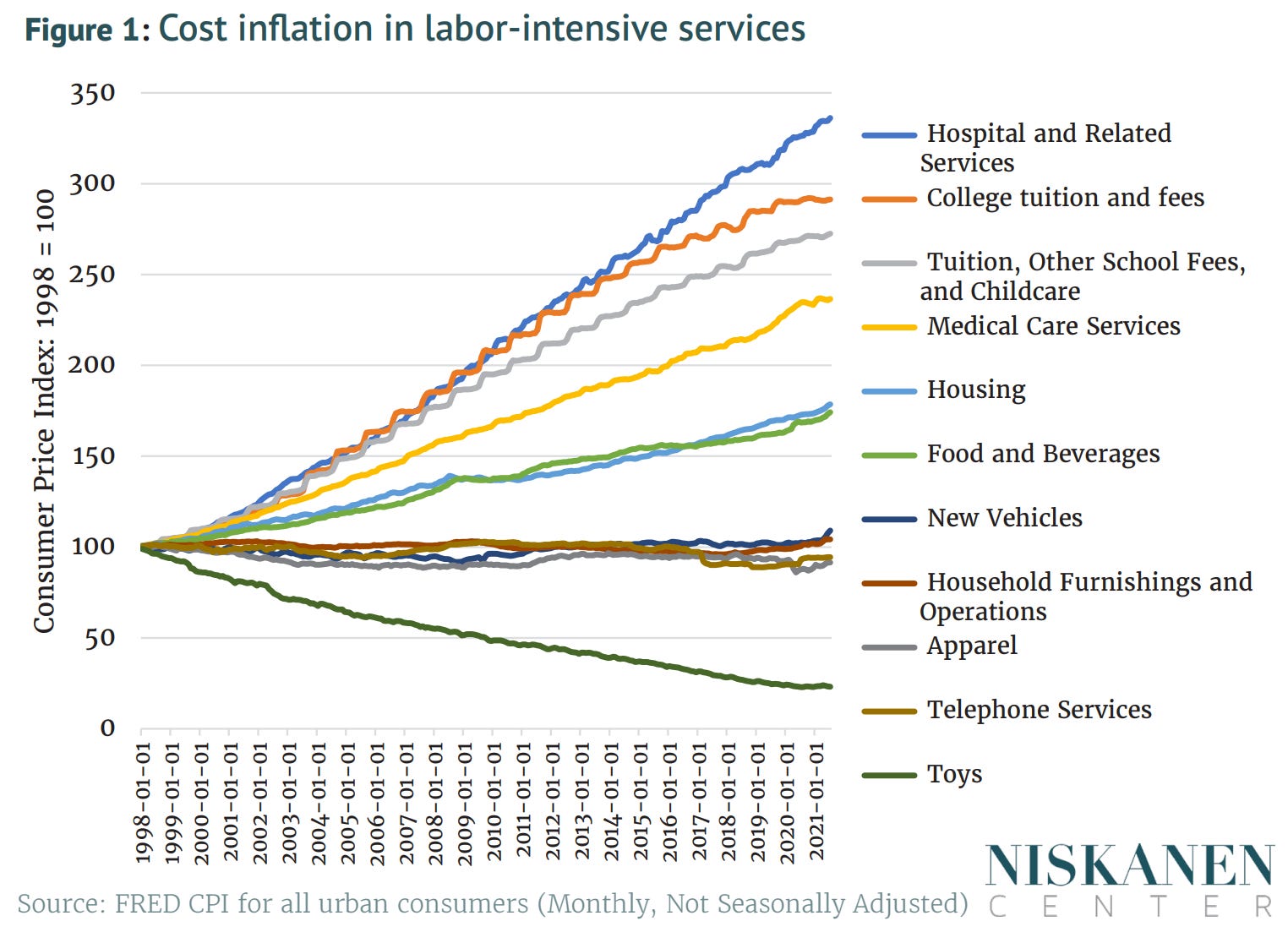
The incredibly high and rising costs of key parts of the U.S. economy—most notably housing and medicine—largely result from government policy restricting supply while subsidizing demand. Not greed. Not monopoly. Not natural limitations.15 “Cost-disease socialism” is what’s bankrupting us. Perversely, the high prices are frequently blamed on market failures, instead of obviously flawed policy strangulating supply and preventing markets from working. We could have more doctors16 and houses and clean energy if we chose to.
Helping the Advantaged
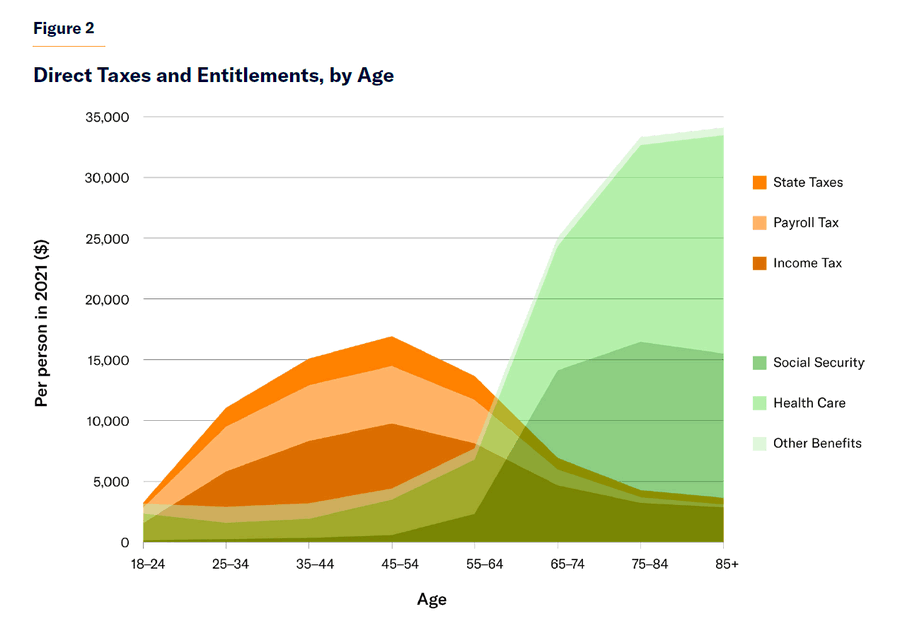
Instead of the welfare state being aimed at alleviating suffering of the disadvantaged, it turns out that it actually is more aimed at the part of society that is, on average, the wealthiest—the elderly. We’ve managed to rig our redistribution net to take away from the young and productive and give more to the old and wealthy. (It’s probably mere coincidence that the elderly are also the most consistent voting bloc, right?)17 Social Security is for all practical purposes a poorly designed Ponzi scheme18 and Medicare costs are ballooning, as the demographic transition makes all this much worse. Deficits are a tax on the future; too bad unborn generations have such low voter turnout.19
“You didn’t [cause] that”
The common narrative is that things got better for workers in the 20th Century because of unions and activists advocating for government policies to improve things. But it’s actually a tale of economic growth allowing us to make our working lives better so that we could afford trade-off costs.
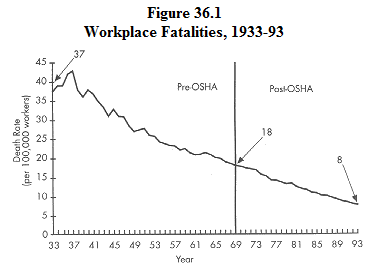
Similarly, the 40-hour work week and end of common child labor are overwhelmingly a story of increased economic productivity and changing workforce needs, not activist achievement via policy.
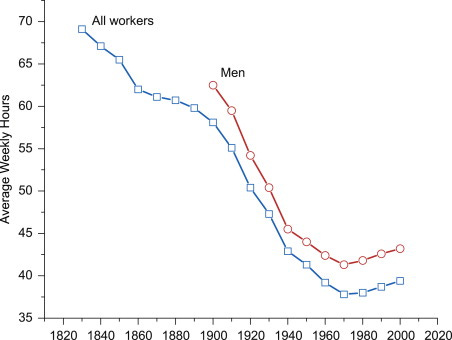
In other words, economic feasibility had to be achieved to consider such things at all; formalizing the changes in law is a lagging indicator after it was economically feasible.
The Bad Deal
The New Deal actually managed to significantly prolong the Great Depression via price controls on goods and wages and other harebrained interventions.
China Shocks, Rusty Belts
The stagnation and decline of the Rust Belt is often attributed to the rise of China, globalism, and free trade. However, the main drivers of the decades-long decline were automation and secular trends in job sector shifts, plus union power20 hurting competitiveness. In contrast, the Sun Belt has done well, and even the areas ostensibly hit by the China shock have all had wage growth since 2001.
Eutopian Europe
“Why can’t we be more like Europe?” They have such nice healthcare and trains21 compared to us, after all. A couple of decades ago, that progressive battle cry sounded at least nice in theory. Now though, we can see the lines diverge.
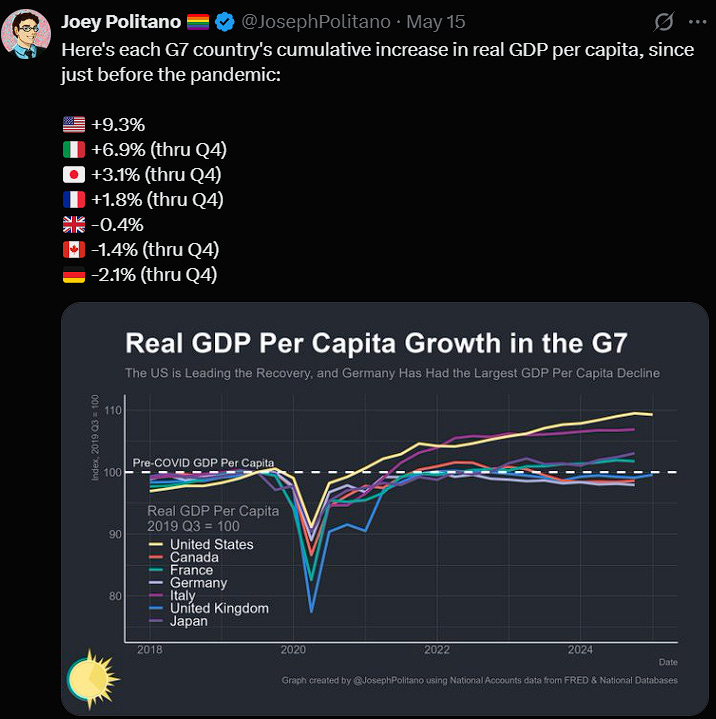
Much of Western Europe is poor and stagnant, and with no air conditioning.22 The famed British NHS is in crisis, as is Britain’s labor force participation, while its “triple lock” pension grows toward infinity during a struggling economy. And poor Germany.
Progressives Against Progress
Perhaps the most powerful indictment of progressivism is looking at the track record of places where progressives have had a monopoly on political power for decades—Blue states and cities. There’s a strong spirit of Blue-tape and degrowth in states like Massachusetts. Blue cities are often terribly managed.
Comparing similarly sized Blue New York and Red Florida is illustrative:
They have comparable populations — New York with about 20 million people, Florida with 23 million. But New York state’s budget is more than double that of Florida ($239 billion vs. roughly $116 billion). New York City, which is a little more than three times the size of Miami-Dade County, has a budget of more than $100 billion, which is nearly 10 times that of Miami-Dade. New York City’s spending grew from 2012 to 2019 by 40 percent, four times the rate of inflation. Does any New Yorker feel that they got 40 percent better services during that time?
What do New Yorkers get for these vast sums, generated by the highest tax rates in the country? (If you are well off in New York City, you pay nearly as much in income taxes as in London, Paris or Berlin — without free higher education or health care.) New York’s poverty rate is higher than Florida’s. New York has a slightly lower rate of homeownership and a much higher rate of homelessness. Despite spending more than twice as much on education per student, New York has educational outcomes — graduation rates, eighth-grade test scores — that are roughly the same as Florida’s.
To summarize, most commonly identified market failures are really policy failures. Economic growth via competitive markets and technological progress is what typically gives us nice things in the war on scarcity, not policy interventions and activism. The efforts of activists, well-intended or not, frequently hurt the productivity improvements we need to improve material well-being at scale, especially in the long run. Usually, critics compare real, imperfect markets to unrealistically effective potential government interventions, which turn out to be worse when actually implemented.
I recommend a strong dose of Classical Liberalism before we drive (further) off a fiscal cliff.
After all that, I should say there has in recent years been a “supply-side” and “abundance” and fiscal responsibility focus from some left-leaning thought leaders such as Matt Yglesias, Noah Smith, and Ezra Klein, and groups like the Center for New Liberalism and the YIMBYs. They do not, in my eyes, take things far enough. But better late than never and I wish them all the luck in the world at shifting the American Left back to an economically informed Third Way that cares about growth and prosperity.
This essay focuses on economic and material issues, not social or cultural. That’s a whole ‘nother essay. I will say that a return to limited government would presumably diminish the intensity of certain fronts of the Culture War. The Founding Fathers understood the importance of an “Ideological DMZ.”
I did have one professor in my MPA program recommend James Q. Wilson’s Bureaucracy, which is excellent. Both as a history of how we got the administrative state we have, and as political theory.
It’s so bad that they will talk about rent control in a positive light.
Where Wilson disagrees with public choice theory, I agree with Wilson.
Some may ask why focus on the economic failures of the Progressive Left at a time when the MAGA Right is in power. Well, as it turns out many of the same blunders have now spread to the MAGA Right. Damn Horseshoe Theory anyway. Moreover, the typical wonk in the relevant professional class leans left by default, and so their views are more institutionally impactful.
This essay was originally drafted in 2025… Personally, I am an anti-anti EA. EA Orthogonal.
Isn’t it incredible that progressives understand diminishing marginal utility so well when talking about justifying progressive taxation, but not when assessing government spending?
Personally, I advocate for Effective Americanism.
We might call such an approach “Consequentialism.”
I assure you they do not.
Probably would though. Might be worth trying.
Sure, wouldn’t that be nice; why couldn’t we do that last time?
Bono agrees: “Aid is just a stop-gap. Commerce—entrepreneurial capitalism—takes more people out of poverty than aid.”
Our World in Data is usually great, but this article is quite bad: Historical poverty reductions: more than a story about ‘free-market capitalism.’ As if government spending as share of GDP in developed countries and poverty reductions in developing countries aren’t both powered by the capitalist wealth engine. As if the massive increase in “public social spending” in the developed world in the latter half of the 20th century had anything to do with global extreme poverty reduction in places like India, China, and Africa.
You know it’s bad when even the AMA, one of the primary culprits of the doctor shortage, is calling for expanded residency and paths for foreign-trained physicians.
Why can’t we be more like Australia or the Netherlands or FERS?
New EA cause area: Longtermism, but for Fiscal Responsibility.
Isn’t it remarkable that progressives so intimately understand the downsides of monopolies, cartels, and special interests when talking about corporations and lobbyists, but not regarding unions and government agencies? The longshoremen are perhaps the single worst example of how unions hurt American progress.