


As so many women are, my wife is so obsessed with Paris.1 The last time we visited was under the agreement that she would get her photoshoot at the Eiffel Tower,2 and I would get my tour of Normandy. There happened to be a Canadian in our small group, so our first stop that rainy morning was the Bény-sur-Mer Canadian War Cemetery.
I did not know in advance that, unlike the markers at the US cemetery, the Commonwealth gravestones could include an inscription from the family of the fallen.
I was already emotionally affected by messages I could read when I saw some markers I could not read. In Hebrew. Imagine those families, their ancestors having fled persecution from Western to Eastern Europe over the course of centuries, then going all the way west to the New World. Only to have their sons dispatched by the Crown back to the Old World to fight on the beaches and in the hedgerows of coastal France. To lie in perpetuity on those sacred fields. Having offered the ultimate sacrifice in defense of societies where explicit antisemitism was common—Canada and the US rejected Jewish refugees as late as 1942 over national security concerns.
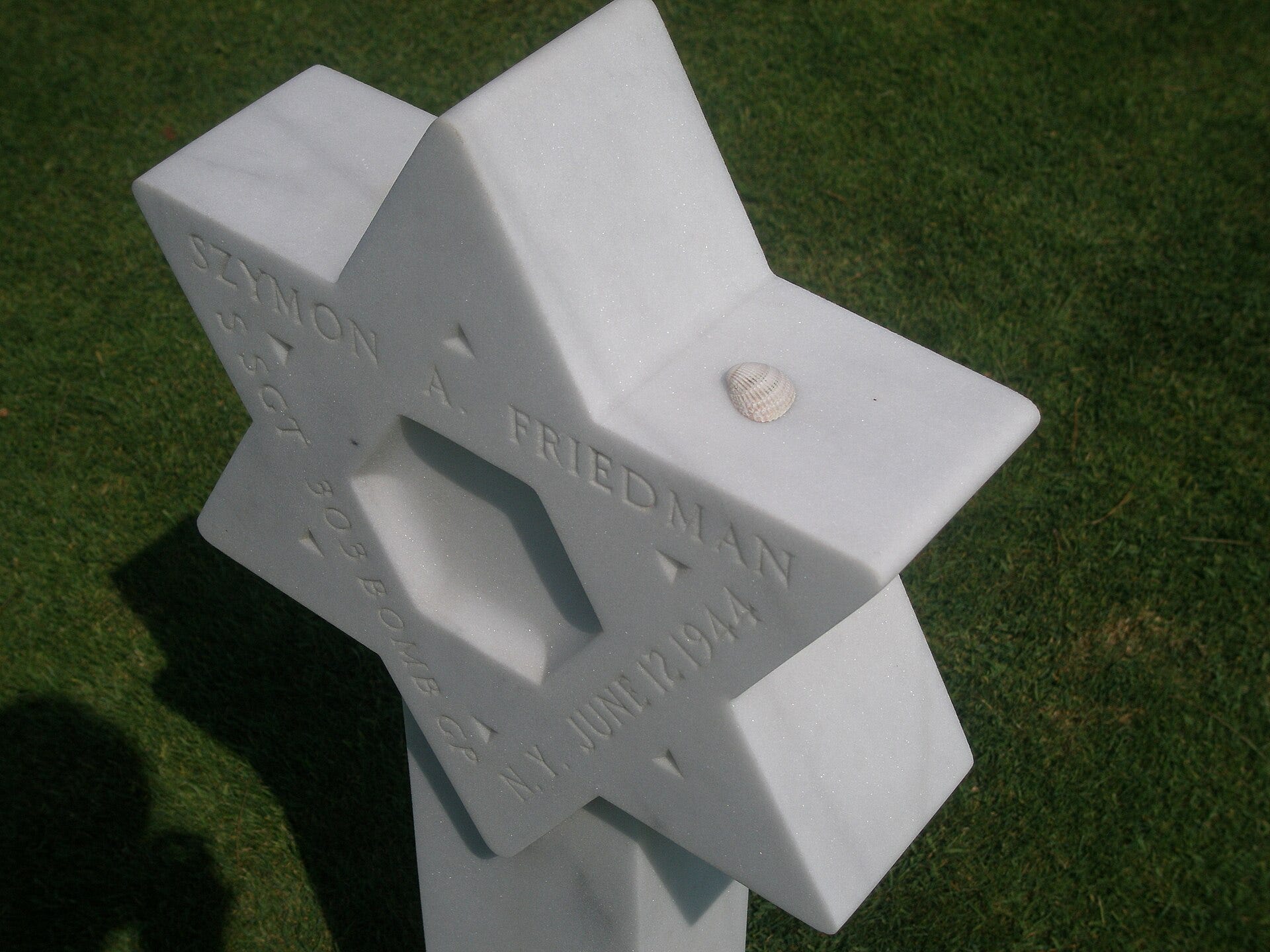
The Stars of David in the Normandy American Cemetery and Memorial sprinkled throughout the field of crosses were not a surprise, at least. We cannot be sufficiently grateful for the service marked by those 9,000 or so white markers. May their memory be a blessing.3
One might also recall the service of the 100th Infantry Battalion, 442nd Regimental Combat Team. Almost entirely made up of American-born second-generation Japanese-Americans. Apparently, General Eisenhower refused to accept the unit under his command in North Africa. So instead they were assigned to support the invasion of Italy. The 442nd RCT would go on to become the most decorated unit in American military history. They would eventually participate in the liberation of concentration camps.
One could also consider the sacrifices of African American servicemembers and Navajo code talkers in WWII, among other categories of disadvantaged minorities. I recently met a second-generation Chinese-American veteran. He had retired from the US Army as an intelligence analyst and now serves on a law enforcement task force focused on AI misuse. During his service, he went no contact with his parents—who were living in the US—as a buffer against potential foreign coercion.
The first foreign national to receive honorary US citizenship, in 1963, was Sir Winston Leonard Spencer Churchill. He was then 88 and would pass away in 1965. His mother had been born in Brooklyn, New York. But the Citizenship Act of 1934 was not retroactive, and so officially Churchill could only be American in blood and in spirit until that moment.
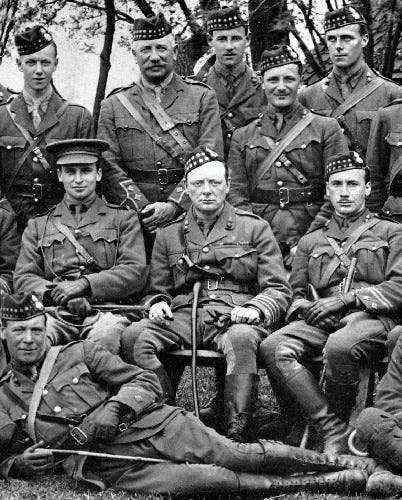

His son read his acceptance remarks, which included these lines:
Our comradeship and our brotherhood in war were unexampled. We stood together, and because of that fact the free world now stands. Nor has our partnership any exclusive nature: the Atlantic community is a dream that can well be fulfilled to the detriment of none and to the enduring benefit and honour of the great democracies.
One set of my maternal great-great-great-grandparents came to the US in 1867 from Denmark. They lost their eldest as they crossed the plains. He was one and a half years old when he was buried on the bank of the Platte River in Nebraska. Their second boy died shortly after his birth, on the last day of 1867 in Brigham City, Utah. My great-great-grandfather was their fifth child and oldest living son. He would volunteer to serve in the Utah Light Artillery and participate in the Spanish-American War, after being mustered into federal service at Fort Douglas, Utah. He ate so many pineapples during his time in the Philippines that he never cared much to eat them again thereafter.
Two decades before 1867, many of my other ancestors were fleeing the United States of America to Mexico to escape religious persecution. Of course, the end result of the Mexican-American War would mean that the State of Deseret would be American territory. A decade after the Mormon pioneers had entered the Salt Lake Valley, federal troops were dispatched to keep a wary eye on them from Camp Floyd. As the Civil War commenced, the Army established Fort Douglas for the Utah garrison, in the foothills overlooking the city from the east. It was part of the 2002 Olympic Village. After two decades of service, various mobilizations, and two combat deployments as a Utah Army National Guard artillery officer—in a unit descended from the Utah Light Artillery—my father would spend almost another decade serving in the Army Reserve unit headquartered there.
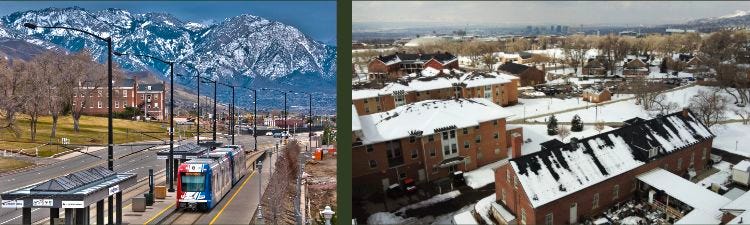

Fort Douglas has now been turned over to the adjacent University of Utah. The old barracks are student housing. I’ve attended a networking event at the old officer’s club. My father’s mother graduated from the U after having fourteen children. I would graduate from the U myself several decades later, though before I had even the one child I do have. My daughter just turned two. She has a Jamestown ancestor on my side and a Mayflower one on her mother’s side.
My father’s father was also a veteran of a foreign war—the First World War. He and my grandmother were married in secret at a mansion in the Sugar House neighborhood of Salt Lake City in early 1944.4 The next month, the home would be raided by FBI agents and local law enforcement. The owner, their marriage officiant, was arrested. Her brother was arrested and convicted later as part of the same case. It was still in those days something of a crime to practice and/or promote the new and everlasting covenant of plural marriage.
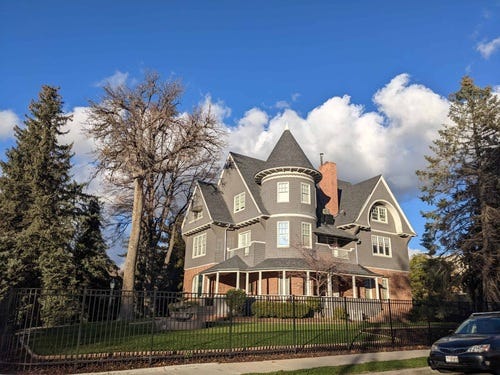
The LDS Church publicly commended the federal government for the action and had even assisted in providing information for the indictments. The case would ultimately go to the Utah Supreme Court. The convictions were vacated. After being arrested in 1953 by the State of Arizona for their religious beliefs,5 my grandparents and the first seven or so of their eventual fourteen children left the United States to escape further persecution. For Mexico, of course—where my grandmother had been born and where my father, last of all, would be born.
As with my paternal grandfather, the US Army sent me off to war in my early 20s. My mother’s service flag had two blue stars on it, as my father’s second deployment overlapped with mine. I suspect my grandfather experienced more indirect fire in France than his son and grandson did in Iraq. I wish I knew exactly where he had served. It’s possible I’ve passed by somewhere he had once been, on the way to Champagne’s wine cellars or the like.6
As part of my small armory, I have on loan from my father-in-law a very functional M1917 Enfield. The “American Enfield” was a British design7 manufactured in America and chambered in .30-06 instead of British .303. American companies had been producing the British version, and so when the US joined the war, it made sense to shift production to the US caliber, instead of trying to mass-produce the Army service rifle, the M1903 Springfield.
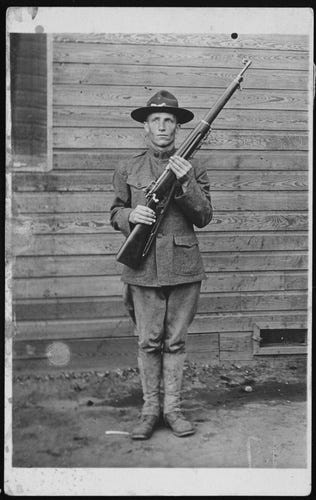
This is the rifle my grandfather would have been issued in WWI. The one under my care was my wife’s great-great-grandfather’s hunting rifle after he purchased it from the Civilian Marksmanship Program. Like me, my father-in-law joined the Army very young and spent some time in the Utah National Guard’s 300th Military Intelligence Brigade (Linguist). Unlike me, he would receive his commission through ROTC and serve on active duty for over two decades. My wife spent about a third of her childhood in Germany, a third in Africa, and a third stateside. She went to kindergarten in Monterey, California, as her father studied at the Defense Language Institute. She lived on Fort Meade, Maryland, when her father was stationed there. I would myself spend some quality time at those installations a decade plus later. She had not lived anywhere for more than two years straight until after she met me. It’s just a coincidence, though, that her uncle was my high school art teacher.
My mother-in-law raised six kids all across the world. After retiring from active duty, they settled in my father-in-law’s ancestral homeland of Cedar City, Utah. Soon thereafter, they adopted two children who had had very, very traumatic experiences at the hands of a local polygamous cult (no relation). My in-laws are utterly devoted to their granddaughter. Though her parents have long since parted ways with Mormonism, our daughter knows nothing of her heritage when she happily sings her little lungs out attending sacrament meeting with her grandparents when we visit.
There is no one right way to be an American. Blood, soil, spirit, or creed. Effective Americanism is about a certain boldness in the face of uncertainty and adversity. Drive, determination, (rugged) individualism with unity, and the idea that things could be made better.
I stand all amazed at the many great Americans, past and present, who have served and sacrificed for their families, communities, and country in critical capacities. We enjoy immense benefits thanks to their bravery and hard work in the pursuit of happiness and to promote the common good.
That work is not done. America is only as exceptional as we make it.
Probably just a coincidence she was born in Berlin.
You know who else had a photoshoot at the Eiffel Tower?
At the very end of the tour, we briefly stopped at the German cemetery. I don’t even know what feelings I felt. Those thousands of black markers are even more of a tragedy than all the white ones. Their deaths were worse than in vain.
Ironically enough, my parents would unwittingly have their wedding open house at this very abode—which had been purchased in the 1980s by the man who had effectively adopted my father when his mother returned to Mexico. Since my grandmother did not attend the open house, the connection was not made until years later when marriage documents were found hidden in the walls (since misplaced, tragically enough). I have fond memories of staying there as a child when we visited from Southern Utah. As it happens, it’s across the street from my grocery store—which I did not realize until after we moved earlier this year. As of this writing, the mansion is surrounded on three sides by a giant pit. By the grace of the Salt Lake City Council, the building had to be preserved as a large apartment complex is built around it. I hope to go inside again someday.
Ironically enough, my grandfather’s first wife, who had borne him eleven children, had left him basically the moment she found out about the whole polygamy thing. (He never married a third wife, strangely.) After their marriage in 1921, they had converted to Mormonism together in Michigan in 1928, and were sealed for time and all eternity in 1930 in the Arizona temple. She received a civil divorce in 1944 and a temple divorce (rare) in 1947, signed by the LDS President, George Albert Smith—the first LDS prophet to not practice polygamy (though his father had). The doctrinal mechanism to cancel this sacred ordinance was quite literally a stamp on the document. (I assume now it’s an entry in a database.) My grandmother was born in 1922. In Mesa, Arizona, my grandfather was helping her brothers roof a house when she was a college student; they convinced him polygamy was necessary for salvation. Among other things. Eight of my ten aunts were polygamist wives, with the eldest six having been married off as teenagers. All three of my uncles were polygamists. My dad decided mainstream Mormonism was the better choice.
That Canadian tourist informed me there is a section of trenches preserved by the Canadian government. I’ll be visiting that next time.
Copied from a Mauser design, ironically enough.